



What property can house an employment-transition support office? Zoning, barrier-free design and fire-safety checkpoints
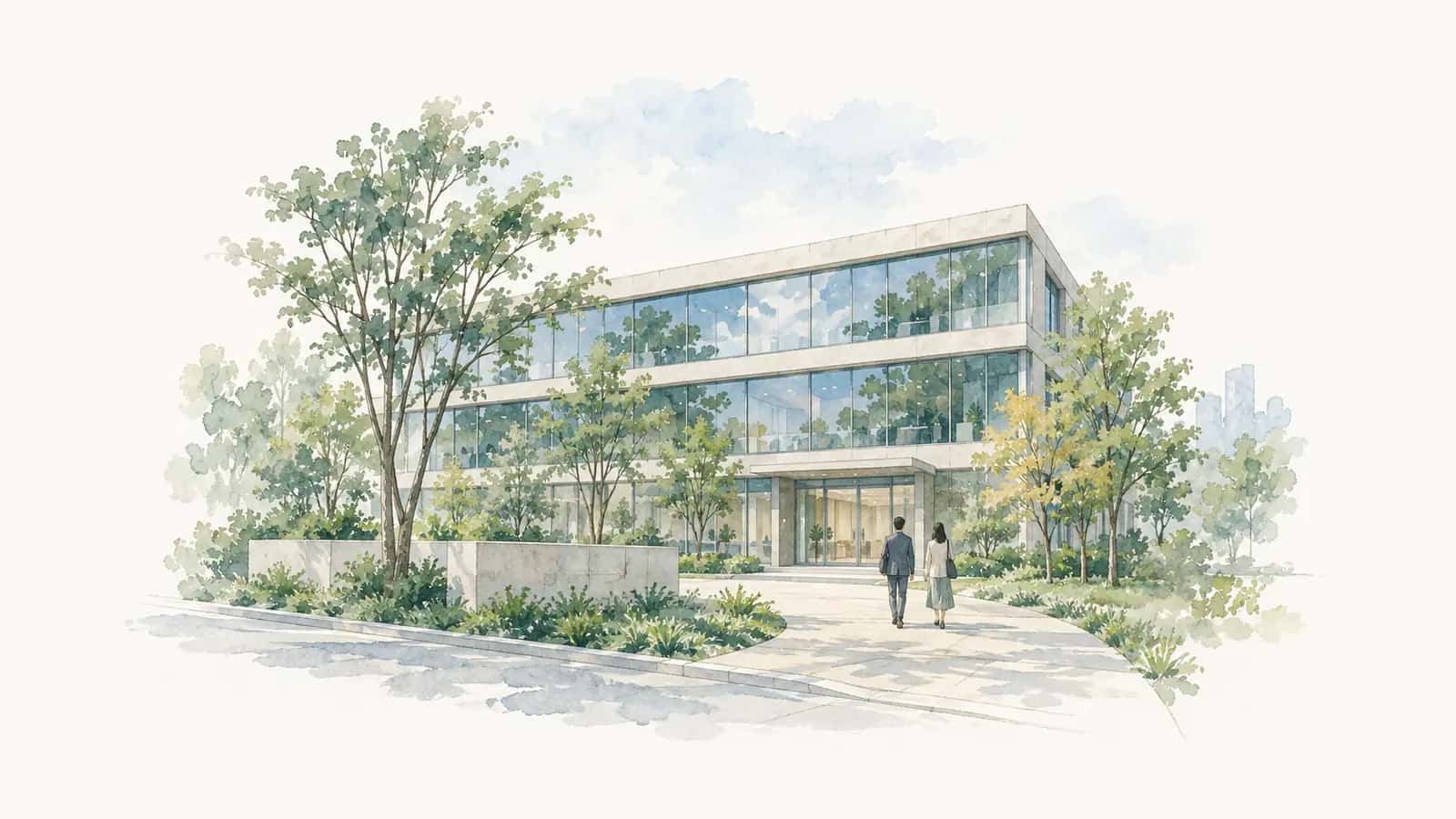

The property for an employment-transition support (shuro-iko shien) office is decided by three things: whether the Building Standards Act use clears, whether you can secure the training/work room and consultation room required by the designation-standard ordinance, and whether the fire-service classification and equipment are adequate. Yotsuba Real Estate Co., Ltd. handles the lease brokerage and use checks; the designation application goes to an administrative scrivener, the change-of-use confirmation to an architect, and staff labour conditions to a labour and social security attorney, under separate, independent contracts.
The key point: Whether a property can house an employment-transition support office is decided by three things: whether the Building Standards Act use clears, whether you can secure the training/work room and consultation room required by the designation-standard ordinance at the needed area, and whether the fire-service classification and equipment are adequate. Employment-transition support (shuro-iko shien) is a training-type benefit under the Act on Comprehensive Support for Persons with Disabilities, with a standard use period of 2 years in principle. Being premised on training and work-placement space for moving into employment is where its starting point differs from type-A and type-B continuous employment support. We handle the property's zoning, whether a change of use is needed, and the fire-safety status; the designation application goes to an administrative scrivener, the change-of-use confirmation to an architect, and labour conditions and social insurance for staff to a labour and social security attorney—each an independent business, contracted with separately.
For operators who want to open an employment-transition support office, and for owners who would lease a property for that use, this article organises "what property can be used," in the order of the Building Standards Act, the designation-standard ordinance, and the Fire Service Act. This is general information; the final judgment on whether designation is granted and whether the facility meets the standards rests with the designating authority (prefecture, designated city, etc.), the architect, and the fire authority.
Yotsuba Real Estate Co., Ltd. (四葉不動産株式会社), based in Bunkyo, Tokyo, provides lease brokerage of business premises and advance checks of zoning and change of use. You can consult us about an employment-transition support property from the stage before you decide on a contract.
What are the basic property requirements for an employment-transition support office?
Employment-transition support provides training in the knowledge and skills needed for work, workplace internships, and job-seeking support, for persons with disabilities who wish to enter general employment. It is one of the designated welfare services for persons with disabilities under the Act on Comprehensive Support for Persons with Disabilities (Act No. 123 of 2005), positioned as a training-type benefit, with a standard use period of 2 years in principle (Enforcement Regulations art. 6-9; even where renewal is allowed, one renewal of up to 1 year is the guide, and 3 or 5 years where a training school for massage/acupuncture/moxibustion practitioners is used).
This premise of "sending people into general employment within 2 years" sets the design starting point apart from wage-type type-B and employment-contract type-A (both continuous employment support). Employment-transition support centres on a training room, an internship space modelled on a workplace, and a consultation room for job-seeking and interviews. Three points mainly matter in choosing a property.
| Axis | What to look at | Basis |
|---|---|---|
| Use under the Building Standards Act | Whether it can be built in that zoning; whether a change-of-use confirmation is needed | Building Standards Act art. 48, appended table 2, art. 87 |
| Facilities under the designation ordinance | Whether you can secure a training/work room, consultation room, washroom, toilet | MHLW Ordinance No. 171 of 2006, arts. 178 and 179 |
| Fire-service classification and equipment | The classification of the fire-defence object and the equipment you can install | Fire Service Act Enforcement Order, appended table 1, item (6) |
The thinking on type-A and type-B properties is in How to check zoning and fire safety for a type-A continuous employment support property (Japanese) and Where a type-B continuous employment support property fails on zoning and fire safety (Japanese). This article covers the property requirements specific to employment-transition support, centred on training and internships.
How do you check zoning and the "use" under the Building Standards Act?
An employment-transition support office falls under "child welfare facilities, etc." in article 19, paragraph 1 of the Building Standards Act Enforcement Order. That paragraph positions, besides child welfare facilities, facilities for elderly welfare and support for persons with disabilities, facilities used for welfare-service businesses for persons with disabilities such as daily-life care, independence training, employment-transition support, and continuous employment support, as "child welfare facilities, etc."; employment-transition support is treated as this use.
Which zoning allows this use is decided area by area by Building Standards Act art. 48, appended table 2, and the articles of Enforcement Order art. 130. When converting an existing building used as an office, shop, or dwelling into an employment-transition support office, whether a change-of-use confirmation is required is a dividing point in choosing a property.
| Item | Basis / point |
|---|---|
| Whether the use applies | Falls under "child welfare facilities, etc." in Enforcement Order art. 19 (1) (employment-transition support is specified) |
| Whether the zoning allows it | Confirm individually by Building Standards Act art. 48, appended table 2, Enforcement Order art. 130 |
| Change-of-use confirmation | If the changed part exceeds 200 m², a confirmation is needed before use (Building Standards Act arts. 6 (1) and 87) |
| Daylighting / evacuation | As a child welfare facility, etc., daylighting and evacuation rules apply more strictly |
Converting from an office or a dormitory (such as a company dormitory) needs a change-of-use confirmation before use if the floor area exceeds 200 m². Even at 200 m² or less, conformity with the daylighting, evacuation, and fire rules is asked separately. The final judgment on zoning conformity and whether a confirmation is needed rests with the designated administrative agency and the architect; we organise the current use and area and connect you to an architect for the confirmation.
How far are barrier-free, training-room and consultation-room area and equipment required?
The designation-standard ordinance (Standards for Personnel, Facilities and Operation of Designated Welfare Services for Persons with Disabilities, MHLW Ordinance No. 171 of 2006) requires, as the facility standards for employment-transition support (arts. 178 and 179), a training/work room, a consultation room, a washroom, and a toilet. The training/work room must be of a size that "does not hinder training or work," and the consultation room must have partitions or the like to prevent conversation from leaking.
Note that the per-user floor area of the training/work room is not set as a nationwide uniform figure. Any "◯ m² per person" shown in private commentary is a guide from practice or recommendation, not a figure in the ordinance itself. We do not assert it here and mark it [unverified], treating confirmation with the designating authority's ordinance/guidance and prior consultation as the premise.
| Facility | What is required | Treatment of area / figures |
|---|---|---|
| Training/work room | Size that does not hinder training or work; necessary machinery and tools | No nationwide m²/person standard; guides are the authority's practice [unverified] |
| Consultation room | Partitions, etc., so conversation does not leak out | — |
| Washroom / toilet | Suited to the users' characteristics | — |
| Multipurpose room, etc. | May double as a consultation room where this causes no hindrance | — |
| Barrier-free | Steps, corridor width, handrails, etc., may be added to by ordinance | Confirm by ordinance / guidance |
The barrier-free level may be added to by the users' disability characteristics and by local ordinance. Because the final judgment on how many m² and which specifications are required rests with the designating authority and the architect, prior consultation with the authority is needed before you commit to a property. The designation procedure is handled by an administrative scrivener under a separate contract.
What about the fire-service equipment and the fire-defence-object classification?
Item (6) of appended table 1 of the Fire Service Act Enforcement Order classifies social welfare facilities, etc.: those where persons who find it difficult to evacuate on their own, for physical or mental reasons, are mainly admitted or use the facility fall under item (6)-ro, and others under item (6)-ha. Employment-transition support, which is day-use and not mainly aimed at users who find evacuation difficult, falls under item (6)-ha in principle, but the fire authority judges individually, considering the service content, the users' evacuation difficulty, and the acceptance arrangements.
| Item | Point |
|---|---|
| Fire-defence-object classification | Day-use employment-transition support is item (6)-ha in principle; mainly serving those who find evacuation difficult may make it (6)-ro |
| Fire-service equipment | By classification, area and number of floors: automatic fire alarm, extinguishers, guide lights, etc.; varies by classification |
| Who judges | The fire authority (fire station / prevention division) judges individually; consult before fixing the property |
| Existing buildings | Whether required equipment can be retrofitted (wiring, compartments) is a dividing point |
Have a question about your situation?
Tell us about your property search or plans to sell.
The specifics and cost of the required fire-service equipment vary with the equipment mix and the building, so here too we do not assert and mark it [unverified], treating confirmation with a fire-equipment officer, architect, and the fire authority as the premise. We organise the existing fire-service equipment and the likely classification as property information, and connect you to each specialist for design, work, and confirmation.
Who do you ask for the designation application, change of use, and labour? (Separate mandates)
Opening an employment-transition support office spans different businesses: real estate, licensing, construction, and labour. Getting the order wrong can lead to contracting a property where a change of use is impossible, backtracking on the fire classification, or reaching opening day before staff labour conditions are arranged.
| Role | Who handles it |
|---|---|
| Survey of property use, structure and fire status; important-matters explanation; lease brokerage | Real-estate transaction business (our company) |
| Designation application as a welfare-service provider; consultation with the authority | Administrative scrivener |
| Change-of-use confirmation; daylighting, evacuation, fire design | Architect / designated administrative agency |
| Labour conditions, work rules, social insurance for vocational instructors, employment-support workers, etc. | Labour and social security attorney |
| Registration such as a change of building description on change of use | Judicial scrivener |
| Billing of fees, accounting, tax | Tax accountant |
The designation application as a welfare-service provider is the work of an administrative scrivener; we do not act as agent. Designing the working hours, breaks, work rules, and social insurance of vocational instructors, employment-support workers, and other staff is the field of the labour and social security attorney.
These are each independent businesses, and you contract with them separately. We handle the check of the property's use, structure, and fire status and the lease brokerage; the designation application goes to an administrative scrivener, the change-of-use confirmation and design to an architect, labour conditions and social insurance to a labour and social security attorney, registration to a judicial scrivener, and accounting and tax to a tax accountant. We neither receive nor pay referral or introduction fees.
How can you consult Yotsuba Real Estate about finding an employment-transition support property?
Those who want to open an employment-transition support office, and owners who would lease a property for that use, can contact Yotsuba Real Estate directly to request property search and lease brokerage. Please first tell us:
- The intended capacity and the content of training/internships (PC work, light work, interpersonal internships, etc.)
- The desired area and the intended size and budget
- Whether you premise a change of use of an existing building, or search anew
- The state of preparation for the designation application as an operator
Yotsuba Real Estate checks the property's zoning, whether a change of use is needed, and the fire status in advance, and tells you what can be confirmed before you decide. The designation application goes to an administrative scrivener, the change-of-use confirmation to an architect, and staff labour conditions and social insurance to a labour and social security attorney—each independent businesses that you contract with separately.
For business-property use in general, see also Consultation on business premises and opening bases (Japanese). In your message, write "looking for an employment-transition support property" and include the capacity and desired area. Without presuming whether it can be used, we begin with organising the property's use and the order in which to proceed to designation, change of use, and labour.
Frequently asked questions
Q. Can employment-transition support open in the same property as type-A and type-B continuous employment support?
A. The use under the Building Standards Act is "child welfare facilities, etc." for all of them, so the zoning, change-of-use, daylighting, evacuation, and fire frameworks overlap. But employment-transition support has a standard use period of 2 years in principle and centres on a training room, internship space, and consultation room aimed at general employment—a different design starting point. Confirm the facility fit with the designating authority and the use judgment with an architect.
Q. I want to turn an office or company dormitory into an employment-transition support office. Is a confirmation needed?
A. If the changed part exceeds 200 m², a change-of-use confirmation is needed before use (Building Standards Act arts. 6 (1) and 87). Even at 200 m² or less, conformity with the daylighting, evacuation, and fire rules is asked separately. That judgment and design are the field of the architect and the designated administrative agency; we organise the current use and area and connect you to an architect.
Q. How many m² per user does the training/work room need?
A. The designation ordinance (MHLW Ordinance No. 171 of 2006, art. 178) only says a "size that does not hinder training or work" and sets no nationwide per-person m². Figures in private commentary are guides from practice or recommendation, not figures in the ordinance (treated as [unverified] here). The needed area varies with capacity, training content, and the authority's ordinance, so confirm by prior consultation before fixing a property.
Q. Can I consult a real-estate company about staff labour conditions and social insurance?
A. No. Designing working hours, work rules, and social insurance for staff such as vocational instructors and employment-support workers is the field of a labour and social security attorney, which we do not handle. The property and use check is ours, the designation application goes to an administrative scrivener, and labour goes to a labour and social security attorney—each independent businesses, contracted with separately.
Sources
The following public materials are starting points for investigation. Laws are amended, so check the current text, enforcement date and latest amendment on e-Gov Law Search. Specific facility/area standards differ by the designating authority's ordinance and guidance. All were consulted on 23 October 2026. They do not establish whether an individual property or business meets designation or each standard. The sources below are in Japanese.
- e-Gov Law Search: Act on Comprehensive Support for Persons with Disabilities (Act No. 123 of 2005; framework of designated welfare services and training-type benefits; positioning of employment-transition support)
- e-Gov Law Search: Standards for Personnel, Facilities and Operation of Designated Welfare Services for Persons with Disabilities (MHLW Ordinance No. 171 of 2006; arts. 178 and 179 = facility standards for employment-transition support: training/work room, consultation room, washroom, toilet; size not hindering training or work; partitions for the consultation room)
- e-Gov Law Search: Enforcement Regulations of the Act on Comprehensive Support for Persons with Disabilities (MHLW Ordinance No. 19 of 2006; art. 6-9 = the standard use period of employment-transition support is 2 years in principle)
- e-Gov Law Search: Building Standards Act Enforcement Order (Cabinet Order No. 338 of 1950; art. 19 (1) positions facilities used for welfare-service businesses including employment-transition support as "child welfare facilities, etc."; zoning by Act art. 48, appended table 2, Order art. 130)
- e-Gov Law Search: Building Standards Act (Act No. 201 of 1950; arts. 6 (1) and 87 = a change of use exceeding 200 m² needs a change-of-use confirmation)
- e-Gov Law Search: Fire Service Act Enforcement Order (Cabinet Order No. 37 of 1961; appended table 1, item (6): where those who find evacuation difficult are mainly admitted/use it, item (6)-ro, otherwise (6)-ha; day-use employment-transition support is (6)-ha in principle, but the fire authority judges individually)
This article provides general information and does not guarantee individual legal judgment, whether designation is granted, or conformity with facility standards. The specific requirements for facilities, personnel, and area are premised on confirmation with the designating authority's (prefecture, designated city, etc.) ordinance and guidance and prior consultation. The per-user area of the training/work room and the required fire-service equipment are not asserted here and are treated as [unverified], premised on confirmation by the authority, an architect, and the fire authority.
Joji Uramatsu (浦松 丈二), Representative Director and licensed real estate transaction specialist, Yotsuba Real Estate Co., Ltd. (四葉不動産株式会社). We provide lease brokerage of business premises and use checks. Author profile
Updated: 23 October 2026
Related Articles
- 2026.09.15Business & Investment Property
A property for Type B continuous employment support or employment transition: use zone, area and fire service
- 2026.08.27Business & Investment Property
A property for an after-school day-service: use zone, ground floor, area and evacuation decide it
- 2026.10.22Business / Investment Property
What kind of property does a food-truck 'commissary' need? Food Sanitation Act licensing, water supply and drainage, and zoning
Feel free to reach out for a consultation
Questions about our column articles are also welcome.
It's fine to start with just one line: “What should I do with this?”
Our representative replies to you personally, and if a property matches your needs, we will introduce it via LINE.
LINE connects you directly to our representative, Joji Uramatsu. Messages are accepted 24/7 and answered in order.
5 min walk from Myogadani Sta. (Tokyo Metro Marunouchi Line)|10:00–18:00 (Closed Tue & Wed)