



Designation for daily-life care (disability welfare): what the premises must meet
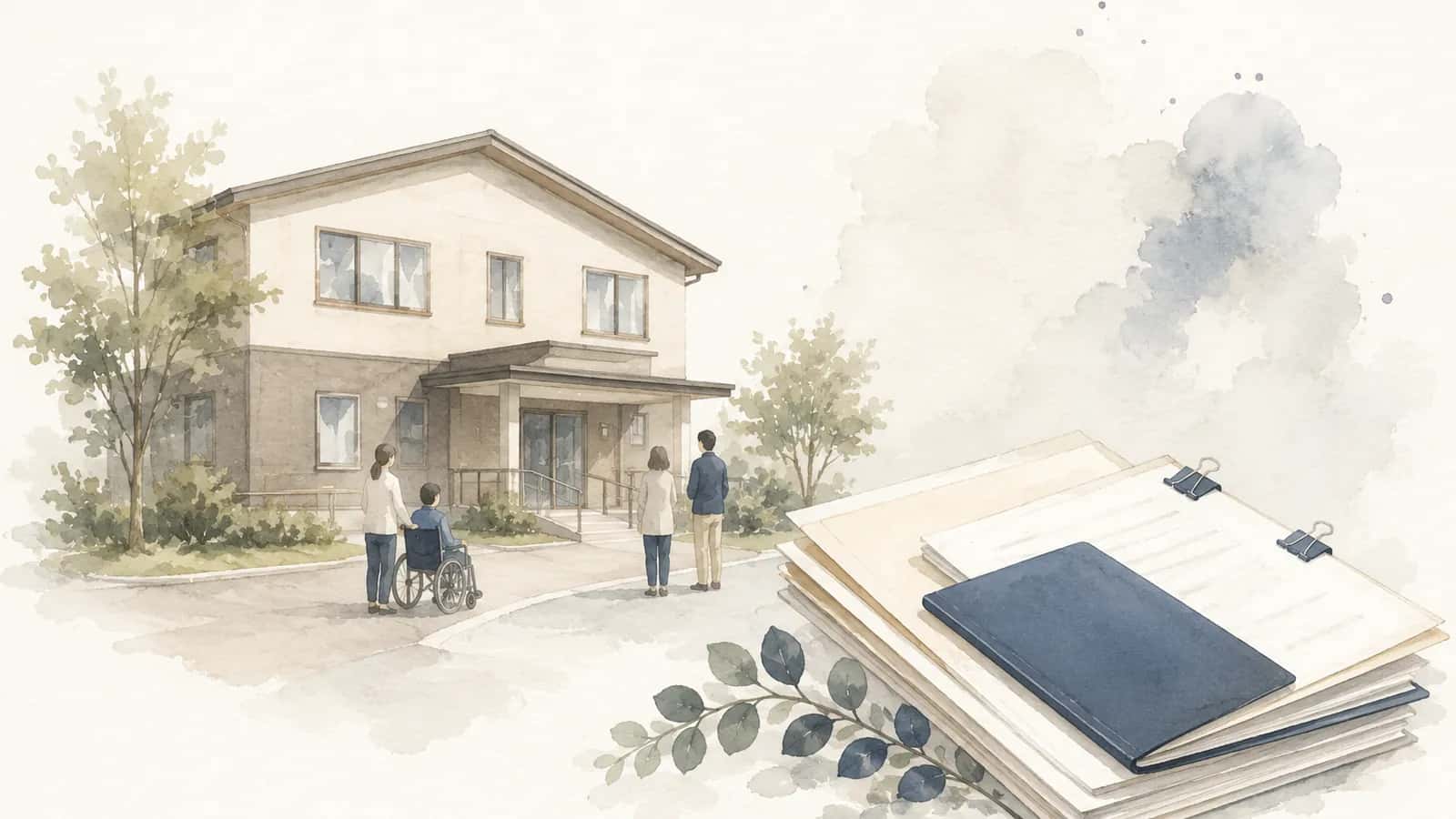

Daily-life care is a disability welfare service under the Comprehensive Support for Persons with Disabilities Act, and starting one requires designation as a designated disability welfare service provider (Article 36). This article organises the designation standards, the premises requirements, and who to ask for building, labour and tax.
In short: daily-life care (seikatsu kaigo) is a disability welfare service defined in Article 5, paragraph 7 of the Comprehensive Support for Persons with Disabilities Act, and to start one you obtain designation as a designated disability welfare service provider (Article 36) from the prefectural governor (in designated cities and core cities, the mayor). The staffing, facility and operation standards are set under Article 43, given concrete form by the national standard, Ordinance of the Ministry of Health, Labour and Welfare No. 171 of 2006, and by each municipality's ordinance. Premises become eligible for designation only when area, facilities and evacuation are all in place, so you prepare the application while securing premises, recruiting staff and confirming building and fire matters in parallel. Eligibility and conformity with the standards are decided by the designating authority's review, and our office does not guarantee designation.
Which laws set the designation standards for daily-life care?
Daily-life care is a service defined in Article 5, paragraph 7 of the Act on Comprehensively Supporting the Daily and Social Lives of Persons with Disabilities (the Comprehensive Support for Persons with Disabilities Act; Act No. 123 of 2005). It is defined as providing, mainly in the daytime, at a support facility for persons with disabilities or other facility, care such as bathing, toileting and meals, opportunities for creative or productive activities, and other benefits, for persons with disabilities who require constant care.
To run the business you need designation as a designated disability welfare service provider under Article 36. The staffing, facility and operation standards are set under Article 43 and, based on the national standard (Ordinance of the Ministry of Health, Labour and Welfare No. 171 of 2006, on the staffing, facilities and operation of designated disability welfare service businesses), are laid down by the ordinances of prefectures, designated cities and core cities. The laws to check therefore form three layers: "the Act → the Ordinance → the municipal ordinance".
| Item | Basis |
|---|---|
| Definition of the service | Comprehensive Support for Persons with Disabilities Act, Article 5, paragraph 7 |
| Designation of the provider | Comprehensive Support for Persons with Disabilities Act, Article 36 |
| Delegation of staffing/facility/operation standards | Comprehensive Support for Persons with Disabilities Act, Article 43 |
| National standard | Ordinance of the Ministry of Health, Labour and Welfare No. 171 of 2006 |
| Concrete standards | Ordinances of prefectures, designated cities and core cities |
For a user to receive support, certification of a disability support category is a prerequisite; daily-life care is in principle for category 3 or above (category 4 or above where facility admission is involved), and the standard is eased for those aged 50 or over. Because the range of categories is set by ministerial ordinance, individual eligibility is confirmed through certification and the municipality's practice.
How many staff does daily-life care require?
The staffing standard is set in Ordinance No. 171 of 2006 and given concrete form by municipal ordinances. The basic placement is as follows.
| Role | Approach to placement |
|---|---|
| Physician | The number needed for users' health management and medical guidance (a part-time contracted physician is acceptable) |
| Nursing staff, physical or occupational therapist, life-support worker | The total of these three roles is placed according to the average disability support category. At least one nursing staff, at least one life-support worker, and at least one of them full-time |
| Service manager | One or more for up to 60 users; for 61 or more, one added per 40 users (including any fraction) |
| Manager | In principle one dedicated full-time person (may hold a concurrent post if there is no hindrance) |
The total of nursing staff, physical or occupational therapist and life-support workers has a lower bound that changes with the average disability support category.
| Average disability support category | Lower bound of the total |
|---|---|
| Below 4 | At least the number of users divided by 6 |
| 4 or above but below 5 | At least the number of users divided by 5 |
| 5 or above | At least the number of users divided by 3 |
Designation for daily-life care in principle requires a capacity of 20 or more users (the approach changes for types such as multi-function offices). The employment contracts, working-hour design, work rules and social-insurance application that meet the staffing standards are the field of a certified social insurance and labour consultant, who contracts with you separately as an independent business.
Where do the premises fail on area or facilities?
The facility standard (Ordinance No. 171 of 2006) requires a training/work room, a consultation room, washbasins, toilets, a multi-purpose room and other facilities needed for operation. The points premises most often fall short on are as follows.
| Facility | Main requirement |
|---|---|
| Training/work room | An area that does not hinder training and work; equipped with necessary machinery and tools. Some municipalities set the per-person area by ordinance, with examples of 3.3 m² or more |
| Consultation room | Able to protect privacy, e.g. by partitions |
| Washbasins / toilets | Number and specification suited to users' characteristics |
| Multi-purpose room | Some municipalities allow it to double as the consultation room where support is not hindered |
Barrier-free features—wheelchair movement, the width of toilets and entrances, the removal of steps—also relate to the Building Standards Act and each municipality's "welfare town-planning" ordinance. Facilities are judged not only on presence or absence but on whether the area, specification and flow lines conform to the standards, so checking the drawings against the actual state at the viewing stage is the shortest way to reduce rework. Premises that fall short of the area or facility standards are not eligible for designation.
From what scale is a change-of-use confirmation application required?
When you turn an existing building such as an office or shop into a daily-life care office, it may amount to a change of use under the Building Standards Act. A disability welfare service business is treated as a "child welfare facility, etc." within the meaning of Article 19 of the Order for Enforcement of the Building Standards Act, and is positioned as a special building under the Act.
When you change use to a special building and the floor area used for that purpose exceeds 200 m², a confirmation application to a building official or a designated confirmation and inspection body is required under Article 87, paragraph 1 of the Building Standards Act, applying Article 6, paragraph 1, item 1 mutatis mutandis. This floor-area threshold was raised from "over 100 m²" to "over 200 m²" and took effect on 25 June 2019 (Reiwa 1). However, even at 200 m² or below, the substantive standards of the Building Standards Act and the Fire Service Act (fire prevention, evacuation, lighting, etc.) still apply, so "no confirmation application needed" and "conforms to the standards" are separate questions.
Whether it is a change of use, and whether a confirmation application is required, is a specialist building judgement based on drawings and the actual state. Ask a licensed architect (the designer) for the design and the confirmation application, together with checking for existing non-conformity and whether an inspection certificate exists. Our company handles the property information and the first-line check of use zone and area, and does not make the building-confirmation judgement.
Where do fire-protection facilities add cost?
A daily-life care office is classified under item (6) of Appended Table 1 of the Order for Enforcement of the Fire Service Act (social welfare facilities, etc.). Even within item (6), the required fire-protection equipment differs between item (6)-ro—facilities mainly admitting persons for whom self-evacuation is difficult—and item (6)-ha—others, centred on day-service use. Day-service daily-life care is generally classified under item (6)-ha, but the use classification varies with the users' condition and the form of the facility.
Whether fire extinguishers, automatic fire alarm systems, guide lights, sprinkler systems and the like are required is decided by the use classification, total floor area, number of storeys and occupant load. In existing buildings, this additional installation is where cost and schedule estimates most easily go wrong. Because the use classification of a fire-defence object and the fire consent are decided by the fire department, consult the fire department with jurisdiction before deciding on the premises. Our company and our office do not judge whether fire-protection facilities are required.
Have a question about your situation?
Tell us about your residency, permit or administrative procedure enquiry.
In what order do the documents and prior consultation for the designation application proceed?
The general flow is as follows. Because things are easily sent back if the order is reversed, start the prior consultation early.
- Fix the business plan and funding plan, and establish a corporation (add disability welfare services to the purpose in the articles of incorporation).
- Choose premises and confirm conformity with the facility standards, the Building Standards Act and the Fire Service Act.
- Hold a prior consultation with the designating authority.
- Secure a service manager, life-support workers, nursing staff and others.
- Prepare the application and attached documents and submit them by the deadline.
- Document examination and, as necessary, on-site confirmation.
- Designation (in many municipalities, as of the first day of a month).
Many municipalities grant designation as of the first of the month, and the submission deadline is generally set in the month or two months before the desired designation date. Deadlines differ by designating authority and may be brought forward at the change of fiscal year, so always confirm on the relevant municipality's official page. Typical required documents are as follows.
- The designation application and the schedule of matters for designation (appendix)
- The corporation's certificate of registered matters and articles of incorporation
- The floor plan, photographs and lease of the office
- The operation rules and the important-matters explanation
- The list of workers' duty roster and forms of duty, certificates of qualification and proof of practical experience, and the completion certificate of service-manager training and the like
- The résumés of the manager and the service manager
- The income and expenditure budget, an outline of measures to handle user complaints, and various written pledges, etc.
Within the scope of administrative-scrivener work, Yotsuba Administrative Scrivener Office supports the preparation of the designation application, appendix and attached documents, the organisation of prior-consultation materials, and the drafting of the operation rules and the like. The final judgement of conformity with the standards and eligibility for designation is made by the designating authority's review.
Who should you ask for premises, building, labour, registration and tax?
The designation application crosses several fields of expertise. The roles are divided as follows.
- Preparation of the designation application, appendix and attached documents, and support for prior consultation → Yotsuba Administrative Scrivener Office (administrative scrivener)
- Selection, lease and important-matters explanation of business premises, and the first-line check of use zone and area → Yotsuba Real Estate Co., Ltd.
- The change-of-use confirmation application and design, and checking existing non-conformity and the inspection certificate → a licensed architect (the designer)
- Judgement on whether fire-protection equipment is required, and fire consent → the fire department
- Employment contracts, work rules, working-hour management and social-insurance application that meet the staffing standards → a certified social insurance and labour consultant
- Corporate establishment and change registration → a judicial scrivener
- Corporate accounting, tax and tax calculation → a tax accountant
- Individual legal judgement on rights, obligations and disputes → an attorney
Yotsuba Administrative Scrivener Office and Yotsuba Real Estate Co., Ltd. are separate businesses. Our office handles only support for the designation application as an independent business, and premises, building, fire, labour, registration and tax are contracted separately with each qualified professional or counter. Our office receives no referral fee. For the whole picture of the licensing of disability welfare services, see Licensing of Disability Welfare Services; for the flow of engagement, see Engagement Flow; and for fees, see Fee Schedule. For a related type of designation application, see also The flow of the designation application for after-school day service and child development support.
FAQ
Q. Can a daily-life care office open in any premises?
A. Besides area, facilities and evacuation, existing buildings may need a change-of-use confirmation application or additional fire-protection equipment. The change-of-use judgement is confirmed with a licensed architect (the designer) and the need for fire-protection equipment with the fire department. Premises are with the real estate company and building confirmation with the architect, each contracted separately as a separate business.
Q. Is a change-of-use confirmation application always required?
A. When you change use to a special building and the floor area used for that purpose exceeds 200 m², a confirmation application is required under Article 87, paragraph 1 of the Building Standards Act. Even where no confirmation application is needed at 200 m² or below, substantive standards such as fire prevention, evacuation and lighting still apply. Whether it is required is a specialist architect's judgement based on drawings and the actual state.
Q. Must all staff be in place before opening?
A. Staff directly tied to the designation requirements, such as the service manager and the full-time requirement, must have their securing status shown at the time of application. Recruitment, the design of working conditions and social-insurance application are the field of a certified social insurance and labour consultant, who contracts with you separately as an independent business.
Q. From how many users is the capacity set?
A. Designation for daily-life care in principle requires a capacity of 20 or more users. Because the approach changes for types such as multi-function offices, confirm the individual capacity with the relevant municipality's ordinance and guide.
Sources (Primary Information)
- e-Gov Law Search, "Act on Comprehensively Supporting the Daily and Social Lives of Persons with Disabilities" (Act No. 123 of 2005), Articles 5(7), 36 and 43 (accessed 2026-08-24)
- e-Gov Law Search / Ministry of Health, Labour and Welfare, "Standards concerning the staffing, facilities and operation of designated disability welfare service businesses under the Comprehensive Support for Persons with Disabilities Act" (Ordinance of the Ministry of Health, Labour and Welfare No. 171 of 2006; promulgated 29 September 2006) (accessed 2026-08-24)
- e-Gov Law Search, "Building Standards Act" (Act No. 201 of 1950), Articles 6(1)(i), 87 and Appended Table 1, and Article 19 of the Order for Enforcement of the Building Standards Act (accessed 2026-08-24)
- Ministry of Land, Infrastructure, Transport and Tourism, "On the enforcement of the Act partially amending the Building Standards Act (Act No. 67 of 2018)" (the scale requiring a confirmation application on change of use revised from "over 100 m²" to "over 200 m²"; effective 25 June 2019) (accessed 2026-08-24)
- e-Gov Law Search, "Order for Enforcement of the Fire Service Act," Appended Table 1 (item (6)) (accessed 2026-08-24)
- The designation-application guides and ordinances of each municipality (prefecture, designated city or core city) (accessed 2026-08-24)
This article is general information and does not guarantee individual eligibility for designation, conformity with the staffing, facility and operation standards, the need for a change-of-use confirmation application or fire-protection equipment, or the application schedule. The final review of designation is made by the designating authority (prefecture, designated city or core city). Confirm whether a change-of-use confirmation application is required and the design with a licensed architect (the designer), the need for fire-protection equipment and fire consent with the fire department, and the deadlines, forms and required documents for each office on the relevant municipality's official page. Selection, lease and important-matters explanation of business premises are handled by Yotsuba Real Estate Co., Ltd.; employment contracts, working-hour management and social-insurance application that meet the staffing standards by a certified social insurance and labour consultant; corporate establishment and change registration by a judicial scrivener; accounting and tax by a tax accountant; and individual legal judgement on rights, obligations and disputes by an attorney, each as an independent business under a separate contract. Our office receives no referral fee. Individual judgements are made by a qualified professional after a meeting. Written by Joji Uramatsu, administrative scrivener and licensed real estate broker.
Let's start by sorting out your situation.
Yotsuba Gyoseishoshi Office (Kohinata, Bunkyo-ku; a 5-minute walk from Myogadani Station on the Tokyo Metro Marunouchi Line) supports you from organizing the requirements through document preparation and application.
LINE connects you directly to our representative, Joji Uramatsu. Messages are accepted 24/7 and answered in order.
5 min walk from Myogadani Sta. (Tokyo Metro Marunouchi Line)|Tue & Wed 10:00–19:00 / Mon, Thu–Sun 18:00–19:00