



Demolishing a vacant house: how does demolition-work registration differ from a construction business permit (demolition)?
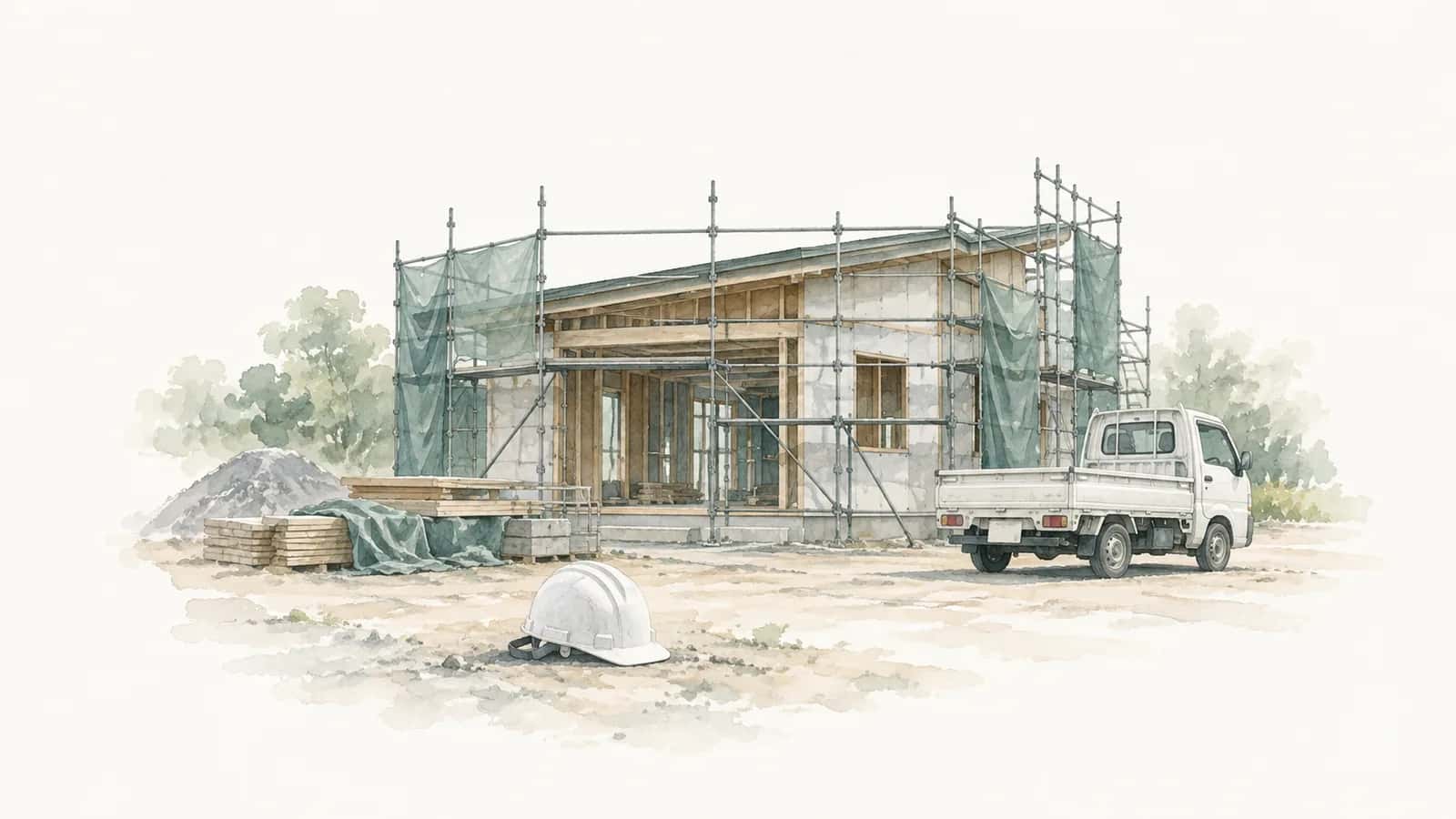

The system for those who take on demolition splits by contract price into demolition-work registration and a construction business permit (demolition). This article organises the split, the technical manager, the pre-notification, the building deregistration, industrial waste, and who to ask for what.
In short: the system for the side that takes on demolition splits, by the amount of the contract price, into "demolition-work registration" and a "construction business permit (demolition)." If you only take on demolition works with a single contract price under 5 million yen (tax included), you need demolition-work registration from the prefectural governor with jurisdiction over the area where you work, under Article 21, paragraph 1 of the Construction Recycling Act. To take on demolition works of 5 million yen or more, you need a construction business permit (demolition) under the Construction Business Act. On the other hand, the orderer (such as a vacant-house owner) has a notification duty under Article 10 of the Construction Recycling Act if a building demolition covers 80 m² or more of floor area, and after demolition the building deregistration under Article 57 of the Real Property Registration Act and proper treatment of rubble as industrial waste come into play. This article is general information organising the split between registration and permit, the technical manager, the notification, the deregistration, industrial waste, and who to ask for what; it does not judge the outcome of any individual registration or permit.
Is what demolition needs "registration" or a "construction business permit"?
The system you need changes with the amount of the demolition work you take on.
| Demolition work you take on (single contract price, tax included) | System needed |
|---|---|
| Only demolition works under 5 million yen | Demolition-work registration (Article 21, paragraph 1 of the Construction Recycling Act). Registration per prefectural governor of the area where you work |
| Demolition works of 5 million yen or more | A construction business permit (demolition), under the Construction Business Act |
Registration is obtained per prefectural governor with jurisdiction over the area where you intend to work, and is renewed every five years. However, a person holding a Construction Business Act permit for civil engineering works, building works or demolition works does not need demolition-work registration in that area. Within the scope of administrative-scrivener work, Yotsuba Administrative Scrivener Office supports confirming whether registration or a permit is required, organising the requirements, preparing documents and acting as agent. The actual demolition is carried out by a registered or permitted demolition operator.
What are the requirements for demolition-work registration and the technical manager?
For demolition-work registration, a technical manager must be placed at the work site, not at each office (Article 31 of the Construction Recycling Act). The technical manager oversees the technical management of the demolition work. Typical ways to qualify are as follows.
| Category | Main requirements |
|---|---|
| Experience only | Eight or more years of practical experience in demolition work, regardless of academic background |
| Designated course plus experience | Two or more years after graduating in a designated course at a university or technical college; four or more years after a high school or specialised school |
| National qualification, etc. | A civil or building construction management engineer, architect, demolition-work engineer (kaitai kōji sekō gishi), or tobi skilled worker, etc. |
Completing a course registered with the Minister of Land, Infrastructure, Transport and Tourism shortens the required experience by one year. Registration also requires not falling under the disqualifications, among other things. Obtaining the national qualification or completing the course itself is a matter for each system.
At what scale does a construction business permit (demolition) become necessary?
To take on demolition works with a single contract price of 5 million yen or more (tax included), registration is not enough — you need a construction business permit (demolition) under the Construction Business Act. Demolition work was newly established as an independent trade category, separated from the demolition included in "scaffolding, earthwork and concrete work (tobi/dokō)," by a revision effective 1 June 2016 (Heisei 28).
The transitional measure that accompanied the new category (the period during which demolition could be carried on under a tobi/dokō permit) ended on 31 May 2019 (Heisei 31), and the engineer deemed-status measure ended on 31 March 2021 (Reiwa 3). Now you must meet the permit criteria for demolition work (managing officer, full-time engineer, financial basis, disqualifications). The whole picture of the construction business permit requirements is organised in What does it take to obtain a construction business permit (managing officer, full-time engineer, financial basis).
After demolishing a vacant house, what about the deregistration and industrial waste?
There are procedures on the orderer's side too, before and after the demolition.
- Advance notification: for works at or above a certain scale (target construction works), such as a building demolition covering 80 m² or more of total floor area, the orderer or self-executing party notifies the prefectural governor of the sorted-demolition plan by seven days before the day work starts (Article 10 of the Construction Recycling Act). Failure is subject to a fine of up to 200,000 yen. In practice, the prime contractor may act on the orderer's behalf under a mandate.
- Building deregistration: when a building is lost, the owner recorded in the description section or the registered owner must apply for the deregistration of the building within one month of the day of loss (Article 57 of the Real Property Registration Act). Failure is subject to a non-penal fine of up to 100,000 yen. This is a registration of description, so the agency application is the work of a land and house surveyor, and the application goes to the Legal Affairs Bureau.
- Treatment of rubble: rubble such as concrete lumps and wood scraps arising from demolition is industrial waste, and its collection, transport and disposal are carried out by permitted operators under the Act on Waste Management and Public Cleansing. How to obtain the industrial waste collection and transport permit is organised in How do you obtain a permit for industrial waste collection and transport?.
Have a question about your situation?
Tell us about your residency, permit or administrative procedure enquiry.
For an inherited vacant house, inheritance registration (a judicial scrivener) is also involved before and after demolition. For the flow of a name change for inherited property, see How do you proceed with inheritance registration?; for whether to sell the land cleared or with the old house, see the desk for inherited real estate and sales, a separate business from Yotsuba Administrative Scrivener Office.
What should the orderer (the vacant-house owner) confirm in advance?
Points to check in advance as the orderer when demolishing a vacant house.
- Whether the contractor holds valid demolition-work registration or a construction business permit (demolition) for that work area (check the registration or permit number)
- Whether it is a target construction work, such as a building demolition of 80 m² or more (whether an Article 10 Construction Recycling Act notification is needed and who files it)
- Who arranges the building deregistration after demolition (the description-section registration is a land and house surveyor)
- Whether the contract provides for proper treatment of rubble and other industrial waste (issuance of manifests)
- For an inherited vacant house, the order of inheritance registration (a judicial scrivener) and sale (real estate)
The roles by field are as follows.
- Confirming whether registration or a permit (demolition) is required, preparing documents and acting as agent → Yotsuba Administrative Scrivener Office (administrative scrivener)
- The actual demolition work → a registered or permitted demolition operator
- Building deregistration (description section) → a land and house surveyor (application to the Legal Affairs Bureau)
- Inheritance registration, company incorporation and other registration → a judicial scrivener
- Collection, transport and disposal of rubble as industrial waste → a permitted industrial waste operator
- Sale of the cleared or old-house land, and property arrangement → Yotsuba Real Estate Co., Ltd. (licensed real estate broker)
Yotsuba Administrative Scrivener Office and Yotsuba Real Estate Co., Ltd. are separate businesses. Each field, including the land and house surveyor and the judicial scrivener, is on the premise that you contract separately with each qualified professional as an independent business, and our office receives no referral fee. For the flow of engagement, see Engagement Flow; for fees, see Fee Schedule; and for the whole picture, see Permits and Applications.
FAQ
Q. Do I need registration or a permit even to demolish my own house myself?
A. Where you execute the work yourself (self-execution), it is not a "business" taken on from another party, so demolition-work registration and a construction business permit are not required. However, if it is a target construction work such as a building demolition of 80 m² or more, you need the Article 10 Construction Recycling Act notification as the orderer or self-executing party. Proper treatment of the rubble is also required.
Q. Which do I need for a demolition of exactly 5 million yen?
A. Minor works are "under 5 million yen," so a demolition work that comes to 5 million yen or more tax-included is not covered by registration and needs a construction business permit (demolition). Where a single work is split without a legitimate reason, the contracts are added together. Check the estimate on a tax-included basis.
Q. Can I ask an administrative scrivener for the building deregistration after demolition?
A. Building deregistration is a registration of description, and the agency application is the work of a land and house surveyor. An administrative scrivener does not act as agent for registration applications. Our office handles the demolition-work registration and construction business permit (demolition) application part, and the deregistration is handled by a land and house surveyor as an independent business under a separate contract. Our office receives no referral fee.
Q. To demolish an inherited vacant house, is inheritance registration needed first?
A. Sorting out the title and rights is involved as a premise for the building deregistration and for placing the demolition order. A name change for inherited property (inheritance registration) is the work of a judicial scrivener, and inheritance registration has been mandatory since 1 April 2024 (Reiwa 6). The order of demolition, sale and registration should be confirmed individually under separate contracts with the judicial scrivener, the land and house surveyor and the real estate side.
Sources (Primary Information)
- e-Gov Law Search, "Act on Recycling of Materials Related to Construction Works" (Construction Recycling Act; Act No. 104 of 2000), Article 10, Article 21 and Article 31 (accessed 2026-09-07)
- e-Gov Law Search, "Construction Business Act" (Act No. 100 of 1949), Article 3, paragraph 1, and Appended Table 1 (demolition work) (accessed 2026-09-07)
- e-Gov Law Search, "Real Property Registration Act" (Act No. 123 of 2004), Article 57 (accessed 2026-09-07)
- e-Gov Law Search, "Act on Waste Management and Public Cleansing" (Act No. 137 of 1970), Article 14 (collection, transport and disposal of industrial waste) (accessed 2026-09-07)
- Ministry of Land, Infrastructure, Transport and Tourism, explanatory materials on "demolition-work registration" and "the construction business permit (new demolition category and transitional measures)" (accessed 2026-09-07)
This article is general information and does not guarantee the outcome of any individual registration or permit, the meeting of requirements, the required documents or the examination period. The registration or permit outcome and examination are matters for the prefecture or the permitting authority. Building deregistration (description section) is handled by a land and house surveyor; inheritance registration, company incorporation and other registration by a judicial scrivener; treatment of rubble as industrial waste by a permitted operator; and sale of cleared or old-house land by Yotsuba Real Estate Co., Ltd. (licensed real estate broker), each as an independent business under a separate contract. Our office receives no referral fee. Individual judgements are made by a qualified professional after a meeting. Written by Joji Uramatsu, administrative scrivener and licensed real estate broker.
Let's start by sorting out your situation.
Yotsuba Gyoseishoshi Office (Kohinata, Bunkyo-ku; a 5-minute walk from Myogadani Station on the Tokyo Metro Marunouchi Line) supports you from organizing the requirements through document preparation and application.
LINE connects you directly to our representative, Joji Uramatsu. Messages are accepted 24/7 and answered in order.
5 min walk from Myogadani Sta. (Tokyo Metro Marunouchi Line)|Tue & Wed 10:00–19:00 / Mon, Thu–Sun 18:00–19:00