



An inherited vacant house: demolish and sell as cleared land, or sell as land with an old house?
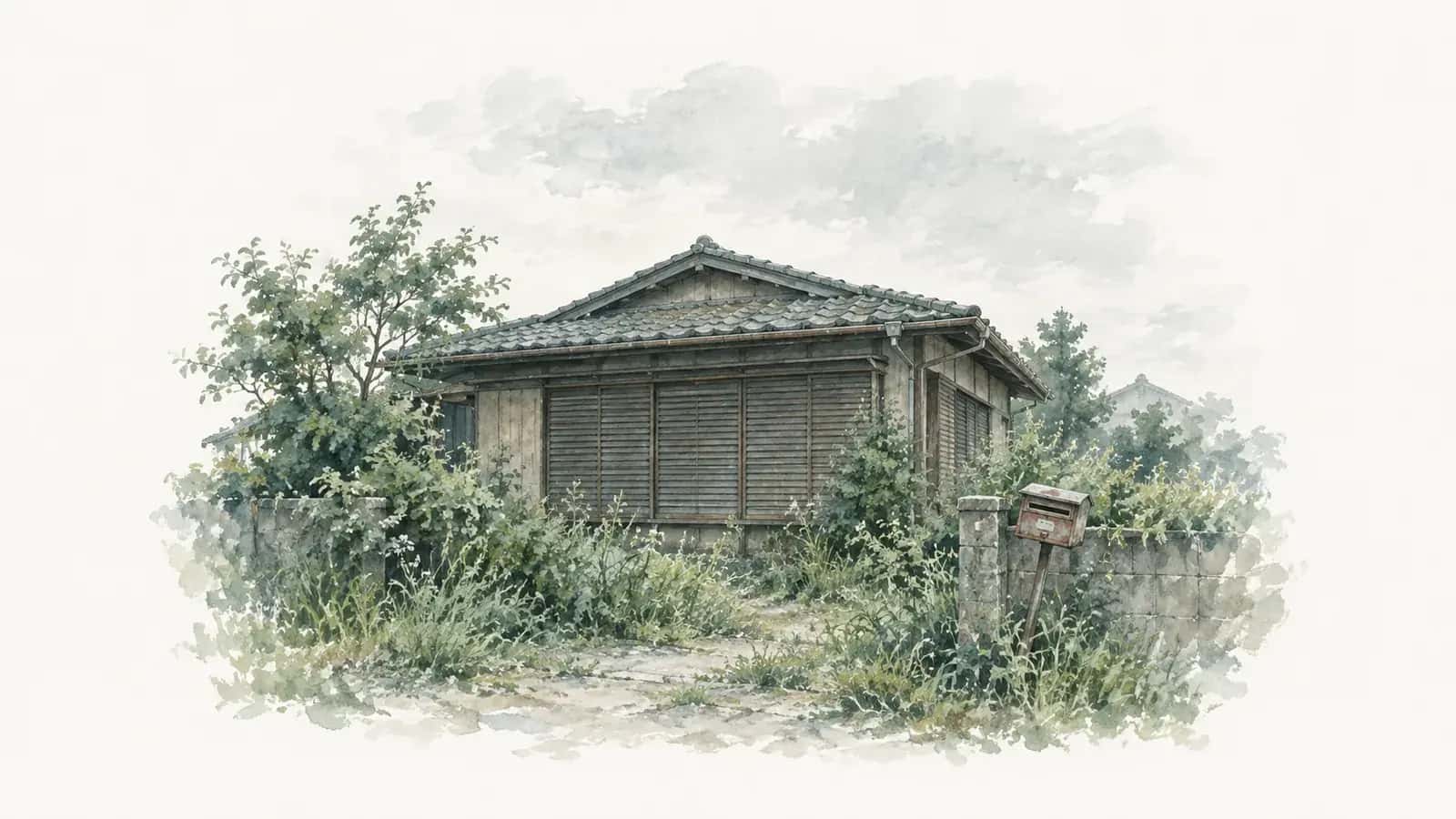

Whether to demolish an inherited vacant house and sell cleared land, or sell it as "land with an old house" (as-is), turns on four things — demolition cost versus the fixed-asset tax that rises once the residential-land measure falls away; the buyer segment; contract-nonconformity liability and who bears demolition; and how the vacant-house 30-million-yen special deduction is applied. Since 2024 the deduction can be used whether you clear the land first or the buyer demolishes after delivery, so the timing of demolition moves your net proceeds. A licensed real estate agent and administrative scrivener in Bunkyo, Tokyo sets out the comparison.
In short: when selling an inherited vacant house, "demolish and sell cleared land" versus "land with an old house (as-is)" turns on four points — (1) demolition cost, and the fixed-asset tax that rises once the residential-land measure falls away after clearing; (2) the buyer segment (cleared land suits those who want to build; land with an old house suits the price-conscious, DIY and investors); (3) contract-nonconformity liability and who bears demolition; and (4) how the vacant-house 30-million-yen special deduction (Article 35(3) of the Act on Special Measures Concerning Taxation) is applied. In particular the deduction is now framed so it can be used either way — you clear the land first, or the buyer demolishes after delivery — so the timing of demolition moves your net proceeds. Tax calculation goes to a tax accountant, and the demolition registration to a land-and-house surveyor / judicial scrivener.
When an inherited family home becomes vacant and you go to sell, you always hit the same fork: demolish before selling, or sell as is. Which is better depends on the property and the buyer; there is no single right answer. This article is for heirs who want to sell an inherited vacant house, setting out the difference between the two ways of selling — cleared land and land with an old house (cost, time, buyer segment, contract-nonconformity liability, tax measures). The risks of leaving it neglected and the reverse-calculation of the deduction are left to other articles; here we focus on the "demolish or not" decision.
Selling cleared land versus land with an old house — what differs to the buyer?
The same lot draws a different buyer segment as cleared land versus with an old house.
Cleared land suits those who want to build now — house makers, spec-home builders. With clear boundaries and no buried objects, a buyer can plan a building at once. Land with an old house (as-is), by contrast, suits those keeping the price down, those assuming DIY or renovation, and those buying to lease as an investment. Even where the old house is given no value, a pricing of "the buyer bears demolition, so priced lower accordingly" can work.
| Cleared land | Land with an old house (as-is) | |
|---|---|---|
| Main buyer segment | Wants to build now; spec-home builder | Price-conscious; DIY; renovation; investment |
| Seller's upfront cost | Demolition comes first | None |
| Time to delivery | Longer by the demolition | Faster |
| Ease of seeing the lot | High (the lot's shape is visible) | The building blocks the view |
Which sells higher depends on location and the building's state. How land value moves with the floor-area ratio is here; the overall "sell or keep" decision is here.
How much should you expect for demolition and the fixed-asset tax rise after clearing? (the tax goes to a tax accountant)
Before clearing, always grasp the fixed-asset tax residential-land special measure.
The Local Tax Act reduces the tax base for land on which a home stands (residential land). Small-scale residential land (the portion up to 200 m²) has its tax base cut to one-sixth, and the portion above that, as general residential land, to one-third (for city-planning tax, one-third and two-thirds respectively). Demolishing the building to clear the land removes this measure, and the fixed-asset tax rises.
It is often said that "clearing makes the fixed-asset tax six times," but that is not accurate. Removing the measure raises the tax base, but cleared land is subject to a burden-adjustment measure and a cap for non-residential land (tax base at 70% of value), so the actual rise is not exactly sixfold. The increase varies by municipality and by assessed value.
| State | Tax base of fixed-asset tax on small-scale residential land |
|---|---|
| A house stands (residential land) | One-sixth of assessed value |
| Demolished, cleared | Measure removed (burden adjustment applies; not exactly sixfold) |
Further, a neglected vacant house designated a "specified vacant house" or "poorly managed vacant house" and subject to a municipal recommendation loses the residential-land measure on its lot (Act on Special Measures Concerning Vacant Houses). Note that the measure can fall away from neglect alone, without demolition. The concrete tax amount and rise are estimated by a tax accountant; confirm the neglect risks separately.
Selling as land with an old house — what about contract-nonconformity liability and demolition cost?
The point when selling land with an old house is contract-nonconformity liability (formerly warranty against defects).
Under the Civil Code, where the thing sold does not conform to the contract, the buyer may demand cure (repair), price reduction, damages, or rescission (Articles 562 et seq.). An old vacant house is prone to leaks, termites and plumbing faults, and selling it as is may expose you to this liability later.
So in used private-party transactions, a special term of "delivered as-is, with no contract-nonconformity liability (exemption)" is often attached. Under the Civil Code this liability can be reduced or waived by special term (though the waiver does not reach facts the seller knew and did not disclose).
Note the case where the seller is a licensed real estate agent and the buyer is an individual (non-agent). There, Article 40 of the Building Lots and Buildings Transaction Business Act makes void any term disadvantageous to the buyer other than one setting the notice period for nonconformity liability to "two years or more from delivery." The exemption term works differently between an individual seller and an agent seller.
| Individual seller | Agent seller, individual buyer | |
|---|---|---|
| Exemption from nonconformity liability | In principle valid (except facts known and not disclosed) | Restricted by Art. 40 (two years or more from delivery, etc.) |
| Demolition cost | Priced in as "buyer bears, so lower" etc. | Adjusted likewise by price / terms |
Whether to "clear at the seller's cost and deliver" or "leave the old house and deliver cheaper at the buyer's cost" is the substance of price negotiation. Which you choose also changes how you use the tax measure below.
If you use the 30-million-yen deduction, what changes with the timing of demolition? (eligibility goes to a tax accountant)
A big factor when selling an inherited vacant house is the "special 30-million-yen deduction on the sale of a deceased person's residence (vacant house)" (Article 35(3) of the Act on Special Measures Concerning Taxation). Up to 30 million yen can be deducted from the capital gain (2 million yen per person where there are three or more heirs).
The main requirements are as follows.
| Requirement | Content |
|---|---|
| Build date | Built on or before 31 May 1981 |
| Building type | Not a sectional-ownership building (condominium, etc.) |
| Residence status | The deceased lived alone immediately before inheritance (special rule for care-home entry, etc.) |
| Use | Not used for business, lease or residence from inheritance to sale |
| Sale price | 100 million yen or less |
| Deadline | By 31 December of the year containing the day three years after inheritance / the measure applies through 31 December 2027 |
| State of the house | At sale, meets the seismic standard, or the house is removed and the land cleared |
Here the timing of demolition matters. Formerly the seller had to seismically retrofit or clear the land by delivery, but for sales on or after 1 January 2024, the case where the buyer seismically retrofits or removes by 15 February of the year after the sale was added to eligibility. In other words, without the seller demolishing first, the deduction can be used even where the buyer demolishes after delivery.
Have a question about your situation?
Tell us about your property search or plans to sell.
This greatly changes the "clear first, or sell with the old house" decision. Eligibility, applying the requirements and the capital-gain calculation are the province of a tax accountant. The requirements are detailed, with special rules for care-home entry and co-ownership. We look at the way of selling (cleared / as-is) and the price design; the tax accountant looks at eligibility — separately.
Demolition, demolition registration and sale — who handles each?
The view on how to sell (cleared / with an old house) and the sale brokerage are undertaken by Yotsuba Real Estate Co., Ltd. (licensed real estate agent, Tokyo Governor (1) No. 113304). The roles divide as follows.
| Order | What to do | Who |
|---|---|---|
| 1 | Inheritance registration (transfer the title from the deceased to the heirs) | Judicial scrivener |
| 2 | Decide cleared / with an old house, and the price | Licensed real estate agent (us) |
| 3 | Demolition work (if clearing) | Demolition contractor |
| 4 | Building demolition registration (within one month of demolition) | Land-and-house surveyor (heading) / judicial scrivener |
| 5 | Eligibility for the 30-million-yen deduction; capital-gain calculation | Tax accountant |
| 6 | Negotiation / mediation if heirs cannot agree on how to sell | Attorney |
After demolishing a building, Article 57 of the Real Property Registration Act requires a building demolition registration within one month of the loss. While the title stands in the deceased's name, neither the sale contract nor the transfer registration can be done, so inheritance registration is a precondition (mandatory since 1 April 2024; see here).
Inheritance registration and the rights section of the demolition registration go to a judicial scrivener, the heading (survey / current state) of the demolition registration to a land-and-house surveyor, the 30-million-yen deduction and capital-gains tax to a tax accountant, and disputes among heirs to an attorney — each engaged directly. These are independent business entities, engaged separately from us. We neither pay nor accept referral fees or introduction commissions. Consultation is free. The overall approach to inherited property is at inheritance and vacant homes.
Frequently asked questions
Q. Is it better to clear before selling, or to sell as land with an old house?
A. There is no single right answer. Cleared land suits buyers who want to build now and is easy to picture, but demolition comes first and, while cleared, the residential-land measure falls away. Land with an old house needs no upfront cost and lists faster, but contract-nonconformity liability and demolition cost must be priced in. Since 2024 the 30-million-yen deduction can be used where the buyer removes after delivery, so decide after confirming eligibility with a tax accountant.
Q. Does demolishing a vacant house make the fixed-asset tax six times?
A. Not exactly sixfold. Demolition removes the residential-land measure (small-scale residential land at one-sixth of the tax base), raising the base, but cleared land is subject to a burden-adjustment measure and a 70%-of-value cap, so the actual rise varies by municipality and assessed value. Ask a tax accountant for a concrete estimate. Note that neglecting it and receiving a "specified vacant house" recommendation can remove the measure without demolition.
Q. If I demolish the building, must I do anything about registration?
A. Yes. Article 57 of the Real Property Registration Act requires a building demolition registration within one month of demolition (loss). The heading section (current state / survey) is the work of a land-and-house surveyor; the rights-section procedure, of a judicial scrivener. If the title stands in the deceased's name, inheritance registration is also needed as a precondition.
Q. Can I sell with an old house and avoid contract-nonconformity liability?
A. Where an individual is the seller, an "as-is, no contract-nonconformity liability (exemption)" term is in principle valid (though the waiver does not reach facts known and not disclosed). Where the seller is a licensed real estate agent and the buyer an individual, Article 40 of the Building Lots and Buildings Transaction Business Act restricts this — the notice period must be two years or more from delivery, and terms disadvantageous to the buyer are void. How the term is drafted varies by the parties and the property, so it is confirmed individually within the brokerage.
Sources (primary)
- National Tax Agency Tax Answer No. 3306, "Special measure on the sale of a deceased person's residence (vacant house)" — Article 35(3) of the Act on Special Measures Concerning Taxation. Built on/before 31 May 1981; not a sectional-ownership building; the deceased lived alone immediately before inheritance; sale price 100 million yen or less; meets the seismic standard or removed (cleared). For sales on/after 1 January 2024, the buyer's retrofit/removal by 15 February of the next year is also covered. 2 million yen per person where three or more heirs. Applies through 31 December 2027. Accessed 27 August 2026.
- e-Gov "地方税法" (Local Tax Act) — Art. 349-3-2 (special measure for the tax base of fixed-asset tax on residential land; small-scale residential land (portion up to 200 m²) at one-sixth, general residential land at one-third; city-planning tax at Art. 702-3, one-third / two-thirds). Accessed 27 August 2026.
- e-Gov "不動産登記法" (Real Property Registration Act) — Art. 57 (on the loss of a building, the heading-section owner or the registered owner must apply for a building demolition registration within one month of the loss). Accessed 27 August 2026.
- e-Gov "民法" (Civil Code) — Arts. 562–564 (contract-nonconformity liability: cure, price reduction, damages, rescission; reduction/waiver by special term). / Building Lots and Buildings Transaction Business Act, Art. 40 (restriction on warranty-term special provisions where the seller is an agent and the buyer a non-agent; two years or more from delivery). Accessed 27 August 2026.
The rise in fixed-asset tax, eligibility for the 30-million-yen deduction, and how the exemption term works all vary by property and by party. This article does not assess any individual property. Confirm finally at the counters: a tax accountant for tax and the deduction, a judicial scrivener / land-and-house surveyor for registration, and an attorney for disputes among heirs. The vacant-house 30-million-yen deduction has detailed requirements, with rules for care-home entry and co-ownership; always confirm eligibility with a tax accountant. This article is general information; it does not judge or guarantee the sale price or tax of any particular property. The view, price design and brokerage are undertaken by Yotsuba Real Estate Co., Ltd. (licensed real estate agent). Inheritance and demolition registration (rights section) go to a judicial scrivener, the demolition registration heading to a land-and-house surveyor, capital-gains tax and the deduction to a tax accountant, and disputes among heirs to an attorney — independent business entities, engaged separately and directly. We neither pay nor accept referral fees.
About the author
Joji Uramatsu — licensed real estate transaction specialist (Tokyo Governor registration No. 293544) and administrative scrivener (registration No. 25087022). Representative Director, Yotsuba Real Estate Co., Ltd. (licensed real estate agent, Tokyo Governor (1) No. 113304); principal, Yotsuba Administrative Scrivener Office. Kohinata, Bunkyo, Tokyo, about five minutes' walk from Myogadani station. Property and paperwork are put on the same table. Full profile: author page.
Related Articles
- 2026.09.27Inheritance
Raising inheritance-tax cash by selling inherited property — a schedule counted back from the 10-month deadline
- 2026.09.26Inheritance
Is it better to give up inherited land to the State treasury, or to sell it?
- 2026.10.09Inheritance
Can inherited branch-family or farm housing be sold? Restrictions on who may use it
Feel free to reach out for a consultation
Questions about our column articles are also welcome.
Sell, rent out, or keep — start with a conversation before you decide.
An inherited family home, a property you own while living abroad, a tenanted building — send us a line on LINE about your situation. Our representative (a Licensed Real Estate Transaction Specialist) replies personally and lays out the outlook for selling, renting out, or keeping it. Appraisal and brokerage are handled solely by Yotsuba Real Estate Co., Ltd.
LINE connects you directly to our representative, Joji Uramatsu. Messages are accepted 24/7 and answered in order.
5 min walk from Myogadani Sta. (Tokyo Metro Marunouchi Line)|10:00–18:00 (Closed Tue & Wed)