



Inheriting a deceased family member's car: how to handle the transfer registration
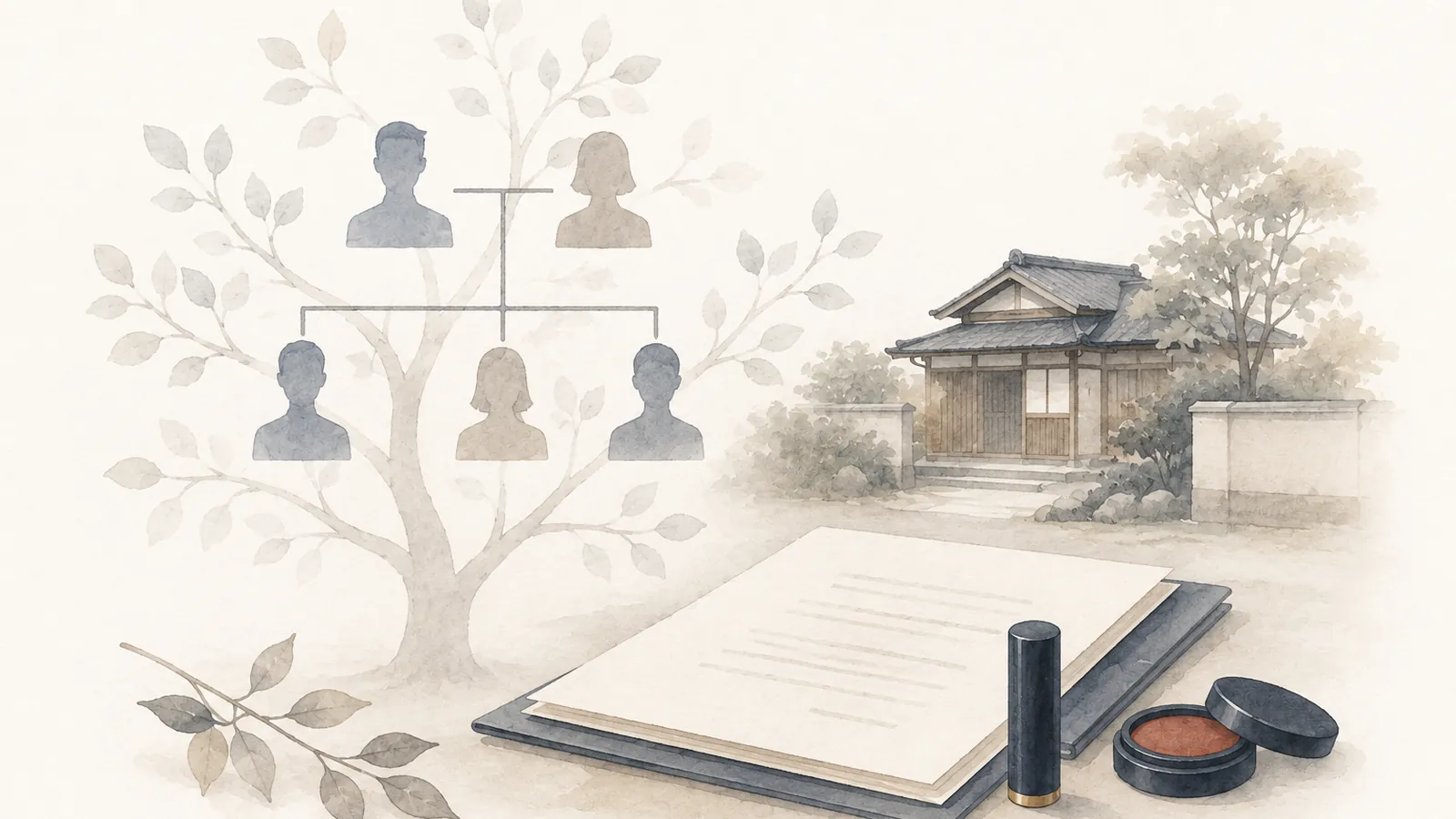

A car in the deceased's name is inherited property and subject to estate division. A registered (standard) car requires transfer registration under Article 13 of the Road Transport Vehicle Act within 15 days; a light vehicle is outside that system. For a standard car appraised at 1 million yen or less, a simplified statement of concluded estate division may replace the division agreement. This article organises the flow, documents and the division of roles.
In short: a car in a deceased family member's name is also inherited property and is subject to estate division. The deceased's property passes to the heirs at the time inheritance opens (Civil Code Article 896); if there are several heirs, the inherited property is once held in co-ownership (Article 898), and who takes it is decided by the estate-division agreement (Article 907). A standard car (registered vehicle) requires, under Article 13 of the Road Transport Vehicle Act, an application for transfer registration (name change) at the District Transport Bureau within 15 days of the transfer of ownership. A light vehicle is outside this registration system, and the procedure is handled at the Light Motor Vehicle Inspection Organization. For a standard car appraised at 1 million yen or less, there is a simplified handling under which a "statement of concluded estate division" may replace the estate-division agreement. This article is general information organising the flow, documents and division of roles; it does not judge any individual inheritance relationship or whether a document is required.
Is a car also subject to estate division?
A car is inherited property in the form of movables and, like deposits and real estate, is subject to estate division. All rights and duties belonging to the deceased's property pass to the heirs when inheritance opens (Civil Code Article 896), and when there are several heirs, the inherited property is once held in co-ownership by the co-heirs (Article 898). Who inherits that car is decided by the co-heirs through the estate-division agreement (Article 907), and if there is a will, the will governs.
Once the person who will inherit it is decided, you need a procedure to change the owner on the inspection certificate (vehicle inspection certificate). The entrance to the procedure differs depending on whether the car is a standard car (registered vehicle) or a light vehicle. When the "owner" on the inspection certificate remains a finance company or dealer (retention of title), the owner's side must act first, so check the certificate's entries first.
How do the procedures differ between a standard car and a light vehicle?
A standard car is subject to the registration system of the Road Transport Vehicle Act, and inheritance involves "transfer registration." A light vehicle is outside the registration system, and the name change is done at the Light Motor Vehicle Inspection Organization (an application to record on the inspection certificate = recording the change of owner). The rough differences are as follows.
| Item | Standard car (registered vehicle) | Light vehicle |
|---|---|---|
| Name of procedure | Transfer registration (Road Transport Vehicle Act Article 13) | Name change (application to record on the inspection certificate) |
| Window | The District Transport Bureau with jurisdiction | The Light Motor Vehicle Inspection Organization |
| Filing period | Within 15 days of the transfer of ownership | Within 15 days of the change of owner (Article 67, paragraph 1 of the Road Transport Vehicle Act) |
| Estate-division agreement | In principle required (except for a sole heir or the statement) | Often not required |
| Parking (storage) space | Parking-space certificate (garage certificate) | In some areas, notification of the storage space |
The main documents for a standard car's transfer registration are the application (Form No. 1), the fee-payment slip (registration stamp; 500 yen for transfer registration), the inspection certificate, a full set of family registers showing the deceased's death and the heirs or a copy of the list of legally designated heirs, the estate-division agreement (not needed for a sole heir), the new owner's seal certificate (issued within 3 months) and registered seal, and the parking-space certificate (within 40 days of the certifying date). When jurisdiction changes, replacing the number plate or bringing in the car may be required. Note that transfer registration by inheritance is outside the online, bundled vehicle-ownership procedure (OSS) and is handled over the counter at the District Transport Bureau. Within the scope of administrative-scrivener work, Yotsuba Administrative Scrivener Office supports preparing these documents and acting as agent for the transfer registration. Whether an individual document is required is a matter for the District Transport Bureau's handling.
Are the documents simpler when the appraisal is 1 million yen or less?
When the standard car to be inherited is appraised at 1 million yen or less, there is a simplified handling under which a "statement of concluded estate division" may replace the estate-division agreement. It may be used only when an appraisal certificate, or a copy of a document showing the appraised value, confirming that the inherited car's value is 1 million yen or less, is attached.
| Category | Document used | Involvement of other heirs |
|---|---|---|
| Ordinary (agreement method) | Estate-division agreement | Signatures, registered seals and seal certificates of all heirs |
| Appraisal 1 million yen or less (statement method) | Statement of concluded estate division + document showing the appraised value | The heir who applies can prepare it alone; the registered seals and seal certificates of the other heirs are not required |
In the statement method, the heir who inherits that car can prepare the statement alone; the applicant's own registered seal is affixed, but the other heirs' consent documents and seal certificates are not required. The appraised value is shown by a document indicating the appraised value issued by a used-car appraiser or a dealer. If it exceeds 1 million yen, or if there is a dispute among the heirs over who takes it, this simplified method cannot be used and the ordinary estate-division agreement is required. Which method applies is determined by the vehicle's appraised value and the inheritance relationship.
Have a question about your situation?
Tell us about your residency, permit or administrative procedure enquiry.
How do you divide the roles from inheritance registration and inheritance tax?
The name change of a car (movable property) and real estate, tax and disputes are each handled by different professionals. The roles are as follows.
- Preparing documents and acting as agent for the car's transfer registration/name change, and preparing the statement of concluded estate division and the parking-space certificate (garage certificate) → Yotsuba Administrative Scrivener Office (administrative scrivener)
- Inheritance registration of real estate (transfer of ownership registration) → a judicial scrivener
- Filing and paying inheritance tax and tax on transfer or valuation → a certified public tax accountant
- Negotiation, mediation and litigation where there is a dispute among the heirs over the estate division itself → a lawyer
Yotsuba Administrative Scrivener Office and Yotsuba Real Estate's inheritance desk, which handles real-estate inheritance, are separate businesses. Each field is on the premise that you contract separately with each qualified professional as an independent business, and our office receives no referral fee. For the overall flow of inheritance, see Engagement Flow for Inheritance Procedures; for fees, see Fee Schedule; and for inheritance services, see Inheritance Procedure Services. The approach to inheritance registration is organised in The Flow of Inheritance Registration, how to make an estate-division agreement in Preparing an Estate-Division Agreement, and the whole picture of what to do after inheritance opens in Inheritance Procedure Checklist.
FAQ
Q. Is there a deadline for a car's name change?
A. A standard car's transfer registration is to be applied for within 15 days of the transfer of ownership, under Article 13 of the Road Transport Vehicle Act. In inheritance it can take time until the estate division is settled, but leaving the name unchanged can cause obstacles in selling, scrapping, car insurance and recall notices, so we recommend acting promptly once the estate division is decided. A light vehicle is also to be processed at the Light Motor Vehicle Inspection Organization within 15 days of the change of owner, under Article 67, paragraph 1 of the Road Transport Vehicle Act.
Q. Is an estate-division agreement needed even with only one heir?
A. If there is only one heir, the estate-division agreement is unnecessary, and the transfer registration can be applied for once that person's status as heir is confirmed by family registers. If there are several heirs, an estate-division agreement (with all heirs' registered seals and seal certificates) is in principle required, but for a standard car appraised at 1 million yen or less it can be replaced by a statement of concluded estate division.
Q. How does a light vehicle's inheritance procedure differ from a standard car's?
A. A light vehicle is outside the registration system of the Road Transport Vehicle Act, and the name change is done at the Light Motor Vehicle Inspection Organization. Even in inheritance, an estate-division agreement is often not required, and the procedure can be completed with relatively simple documents such as the new owner's residence record. Because the handling can change, however, confirm the required documents in the latest guidance of the Light Motor Vehicle Inspection Organization.
Q. Can I have the car's name change done together with inheritance tax and the real-estate registration?
A. An administrative scrivener can handle the car's name change, but the filing of inheritance tax is for a certified public tax accountant, the real-estate inheritance registration for a judicial scrivener, and disputes among the heirs for a lawyer, with the qualifications divided. Yotsuba Administrative Scrivener Office advises on the premise that you contract separately with each qualified professional as an independent business, and receives no referral fee.
Sources (Primary Information)
- e-Gov Law Search, "Road Transport Vehicle Act" (Act No. 185 of 1951), Article 13 (transfer registration), Article 67, paragraph 1 (changes to the matters recorded in the vehicle inspection certificate) (accessed 2026-09-22)
- e-Gov Law Search, "Civil Code" (Act No. 89 of 1896), Article 896 (general effect of inheritance), Article 898 (effect of co-inheritance), Article 907 (agreement for division of the estate) (accessed 2026-09-22)
- Ministry of Land, Infrastructure, Transport and Tourism and the District Transport Bureaus, "Procedure and required documents for a car's inheritance (transfer registration)" and "Statement of concluded estate division" (usable when a document confirming the inherited car's value is 1 million yen or less is attached; accessed 2026-09-22)
- Light Motor Vehicle Inspection Organization, "Name-change procedure (including a change of owner by inheritance)" (accessed 2026-09-22)
This article is general information and does not guarantee whether a document is required in an individual inheritance relationship, the valuation of the appraisal, or the acceptance of the procedure. The outcome and examination of transfer registration are for the District Transport Bureau, and the light-vehicle procedure is for the Light Motor Vehicle Inspection Organization. Real-estate inheritance registration is by a judicial scrivener; the filing of inheritance tax by a certified public tax accountant; and negotiation, mediation and litigation where there is a dispute among the heirs by a lawyer, each as an independent business under a separate contract. Our office receives no referral fee. Individual judgements are made by a qualified professional after a meeting. Written by Joji Uramatsu, administrative scrivener and licensed real estate broker.
Let's start by sorting out your situation.
Yotsuba Gyoseishoshi Office (Kohinata, Bunkyo-ku; a 5-minute walk from Myogadani Station on the Tokyo Metro Marunouchi Line) supports you from organizing the requirements through document preparation and application.
LINE connects you directly to our representative, Joji Uramatsu. Messages are accepted 24/7 and answered in order.
5 min walk from Myogadani Sta. (Tokyo Metro Marunouchi Line)|Tue & Wed 10:00–19:00 / Mon, Thu–Sun 18:00–19:00