



Statutory heirs and statutory shares: inheritance order, inheritance by representation and the basic shares
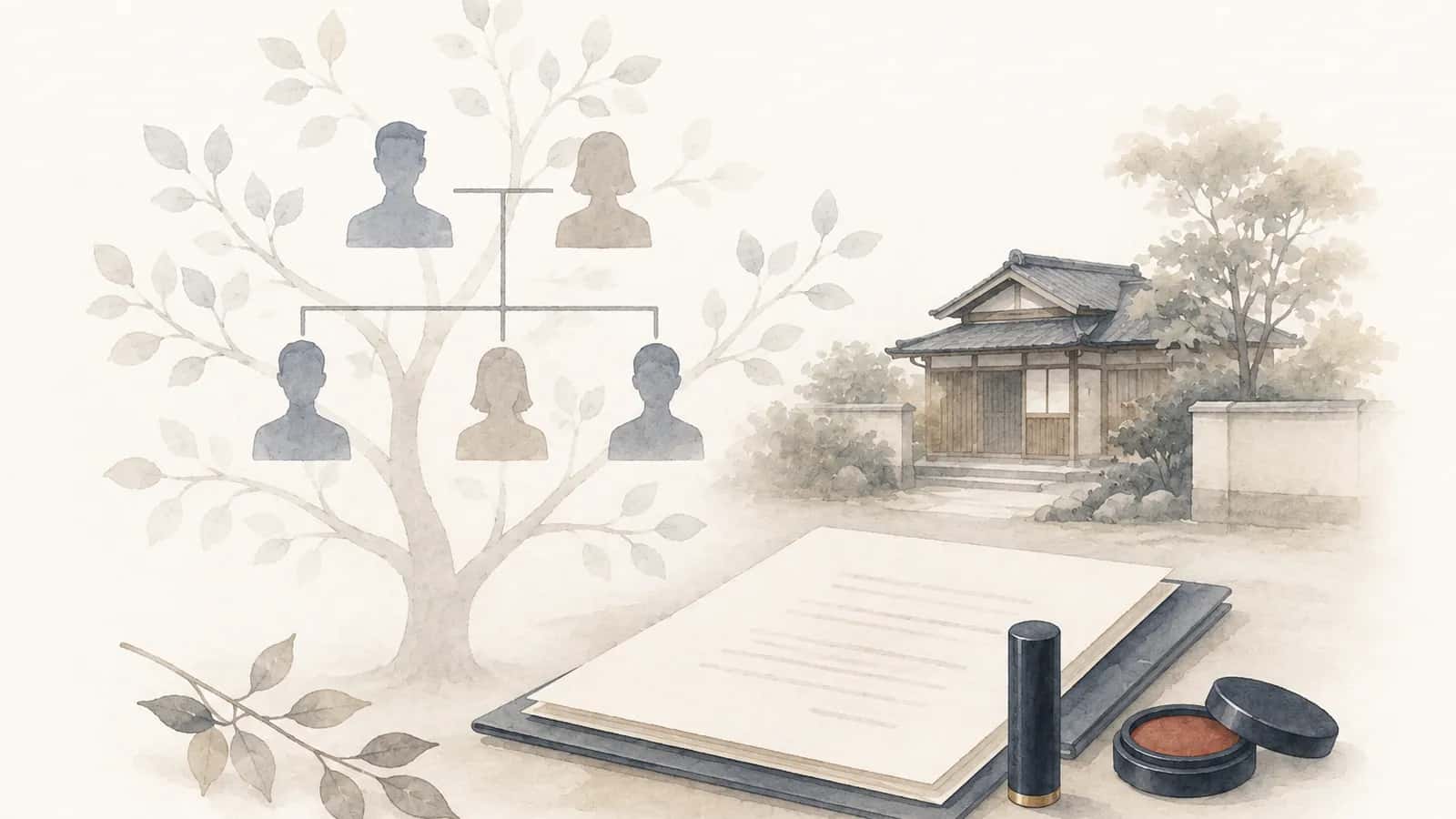

The range of heirs and their order of priority are fixed by the Civil Code, and the spouse is always an heir apart from the order. This article explains the order of succession, inheritance by representation and further representation, the shares of half-blood siblings, the spouse and de facto spouse, and the basic statutory shares.
In short: the range of heirs and their order of priority are fixed by the Civil Code, and the spouse is always an heir apart from the order. The statutory share is the standard fixed by the Civil Code for the shares of co-heirs; the actual acquisition of assets can differ through a will or an estate division agreement. An administrative scrivener investigates the heirs based on the family registers, organises the inheritance relationship, prepares the certified list of statutory heirs, and prepares an estate division agreement based on agreed content. Disputes over parentage, eligibility for disqualification or exclusion, the legally reserved portion and disputes among heirs are handled by an attorney; tax by a tax accountant; and inheritance registration by a judicial scrivener.
What is a statutory heir? First check the order of succession in a quick-reference table
A statutory heir is a person who inherits the deceased's property under the Civil Code. Heirs have an order of priority, roughly as follows.
| Order | Heir | Notes |
|---|---|---|
| First | Children (lineal descendants) | Children come first; if a child predeceased, grandchildren, etc., inherit by representation |
| Second | Parents and grandparents (lineal ascendants) | When there is no first-order heir; the closer in degree is preferred |
| Third | Siblings | When there is no first- or second-order heir; if a sibling predeceased, nieces and nephews inherit by representation |
| ― | Spouse | Always an heir regardless of the order |
The spouse is always an heir, apart from the above order (Civil Code, Article 890). For how to identify the actual heirs from the family registers, see Where to start with an inheritance.
First order: children, inheritance by representation and further representation
If the deceased has children, the children are the first-order heirs (Civil Code, Article 887, paragraph 1).
If a child predeceased the deceased, or lost the right of inheritance by disqualification or exclusion, that child's child (a grandchild) inherits by representation (Article 887, paragraph 2).
If that grandchild also predeceased the deceased, the grandchild's child (a great-grandchild) may inherit by further representation. In representation among lineal descendants, representation can continue down the generations in this way.
An adopted child inherits as a legal child in the first order. However, whether the adopted child's own child can inherit by representation can differ depending on the timing of the adoption and the birth. This article does not go into that point.
Second order: lineal ascendants such as parents and grandparents
If there is no child (lineal descendant), lineal ascendants such as parents and grandparents are the heirs (Civil Code, Article 889, paragraph 1, item 1).
Among lineal ascendants, the one closer in degree comes first. For example, if the parents are alive, the parents inherit; if the parents have already died, the grandparents inherit.
Third order: siblings and inheritance by representation — down to nieces and nephews
If there is no lineal descendant or lineal ascendant, siblings are the heirs (Civil Code, Article 889, paragraph 1, item 2).
If a sibling predeceased the deceased, that sibling's child — a niece or nephew — inherits by representation (Article 889, paragraph 2). However, representation among siblings stops at nieces and nephews; there is no further representation as with lineal descendants.
Is the spouse always an heir? What about a de facto spouse?
A spouse in a legal marriage is always an heir, regardless of the order (Civil Code, Article 890).
On the other hand, a de facto spouse (a partner in a common-law marriage without a legal marriage) is not an heir. To leave property to a de facto spouse, a different measure such as a will should be considered.
What are the statutory shares? The basics for spouse, children, parents and siblings
The basic statutory shares are as follows (Civil Code, Article 900).
| Combination of heirs | Spouse's share | Share of the other heirs |
|---|---|---|
| Spouse + children | 1/2 | Children, 1/2 in total |
| Spouse + lineal ascendants | 2/3 | Lineal ascendants, 1/3 in total |
| Spouse + siblings | 3/4 | Siblings, 1/4 in total |
If there are several heirs of the same order, they divide equally in principle. This is the statutory share (a standard), and it does not necessarily have to be followed in a will or an estate division agreement.
When there are several siblings: the share of half-blood siblings
If there are several siblings, they divide equally in principle.
However, the share of a sibling who shares only one parent (a half-blood sibling) is half the share of a sibling who shares both parents (a full-blood sibling) (Civil Code, Article 900, item 4, proviso).
How renunciation, disqualification and exclusion change the heirs
- Disqualification from inheritance: a person falling under certain grounds (Civil Code, Article 891) cannot be an heir.
- Exclusion of a presumptive heir: a system in which, on the deceased's petition, the Family Court excludes a presumptive heir on certain grounds (Article 892).
- Renunciation of inheritance: the person who renounces is deemed never to have been an heir with respect to that inheritance (Article 939).
The relationship with inheritance by representation is as follows.
- In the case of the deceased's death, disqualification or exclusion, that person's child may inherit by representation.
- Renunciation is treated as the renouncing person having never been an heir. The renunciation itself is not a ground for that person's child to inherit by representation.
Have a question about your situation?
Tell us about your residency, permit or administrative procedure enquiry.
No individual judgement on these is made here.
Are the statutory share and the actual estate division the same?
The statutory share is the standard fixed by the Civil Code for the shares of co-heirs. The actual acquisition of assets can differ through a will or an estate division agreement.
The result of an estate division agreement is documented in an estate division agreement (Can you prepare an estate division agreement yourself?). For wills, see Holograph wills vs notarised wills.
An inherited debt is not treated like an estate division; in principle it is succeeded to according to the statutory shares.
What an administrative scrivener can and cannot do
An administrative scrivener investigates the heirs based on the family registers, organises the inheritance relationship, prepares the certified list of statutory heirs, and prepares an estate division agreement based on agreed content.
- Heir investigation: Where to start with an inheritance?
- Certified list of statutory heirs: What is the certified list of statutory heirs?
- Foreign national or overseas heirs: Inheritance when an heir lives overseas or is a foreign national
Disputes over parentage, eligibility for disqualification or exclusion, the legally reserved portion, and disputes among heirs — these individual legal judgements and dispute handling are the domain of an attorney; tax is a tax accountant; inheritance registration is a judicial scrivener; and the sale and management of real estate is a licensed real estate brokerage (Yotsuba Real Estate). Each is an independent contract, and our office receives no referral fee.
How procedures proceed from the heir investigation in Bunkyo
Yotsuba Administrative Scrivener Office (Kohinata, Bunkyo, about five minutes' walk from Myogadani Station) guides you in stages from the heir investigation based on the family registers to the certified list of statutory heirs, the estate division agreement and the drafting of a will. For the flow of engagement, see Engagement Flow; for fees, see Fee Schedule; and for the whole picture, see Inheritance, Wills and Trusts.
For the sale and management of inherited real estate, see Complete Guide to Inherited Real Estate (Yotsuba Real Estate). Yotsuba Real Estate Co., Ltd. handles this as a separate business under a separate contract from Yotsuba Administrative Scrivener Office.
FAQ
Q. If there are no children, who are the heirs?
A. If there is a spouse, the spouse is always an heir, and if there are lineal ascendants (parents, grandparents), they are also heirs. If there are no lineal ascendants either, siblings are the heirs. The order must be confirmed from the family registers.
Q. What is the spouse's share?
A. If the spouse and children are heirs, the spouse takes 1/2 and the children take 1/2 in total; if the spouse and lineal ascendants are heirs, the spouse takes 2/3 and the lineal ascendants take 1/3; if the spouse and siblings are heirs, the spouse takes 3/4 and the siblings take 1/4 (Civil Code, Article 900).
Q. Can a grandchild be an heir?
A. If a child predeceased the deceased, a grandchild can inherit by representation. If the child is alive, the child is in principle the heir.
Q. If a child renounces the inheritance, does the grandchild inherit instead?
A. Renunciation is treated as the renouncing person having never been an heir, so the child's renunciation is not by itself a ground for the grandchild to inherit by representation. The treatment of representation differs between death/disqualification/exclusion and renunciation.
Q. Must the estate be divided according to the statutory shares?
A. No. The statutory share is a standard; a different division can be set by an estate division agreement by all the heirs or by a will.
Sources (Primary Information)
- Civil Code, Article 887 (children and their representatives; further representation)
- Civil Code, Article 889 (order of succession of lineal ascendants and siblings, and representation)
- Civil Code, Article 890 (the spouse is always an heir)
- Civil Code, Article 900 (statutory shares; the share of half-blood siblings)
- Civil Code, Article 901 (shares of heirs by representation)
- Civil Code, Articles 891 and 892 (grounds for disqualification; exclusion of a presumptive heir)
- Civil Code, Article 939 (effect of renunciation of inheritance)
This article provides general information and does not guarantee the range of heirs, shares, legally reserved portion, or the applicability of renunciation, disqualification or exclusion in any individual case. Disputes over parentage, eligibility for disqualification or exclusion, the legally reserved portion and disputes among heirs are handled by an attorney; tax by a tax accountant; inheritance registration by a judicial scrivener; and real estate by a licensed real estate brokerage, each as an independent business under a separate contract. Our office receives no referral fee. Individual judgements are made by a qualified professional after an interview. Written by Joji Uramatsu (Administrative Scrivener and Real Estate Transaction Specialist).
Let's start by sorting out your situation.
Yotsuba Gyoseishoshi Office (Kohinata, Bunkyo-ku; a 5-minute walk from Myogadani Station on the Tokyo Metro Marunouchi Line) supports you from organizing the requirements through document preparation and application.
LINE connects you directly to our representative, Joji Uramatsu. Messages are accepted 24/7 and answered in order.
5 min walk from Myogadani Sta. (Tokyo Metro Marunouchi Line)|Tue & Wed 10:00–19:00 / Mon, Thu–Sun 18:00–19:00